
I’ve definitely slimmed down. Only problem is, those things are so tiny that I’m always hungry. Some gravy would help.
I’ve definitely slimmed down. Only problem is, those things are so tiny that I’m always hungry. Some gravy would help.

Remember back before the election when that restaurant owner in West Yellowstone told ABC News that he wished Trump would win the election and fire 1,000 National Park Rangers?
Remember, in November of 2025, when black voters told exit pollsters that they were switching to Trump because they wanted him to strip the name of Medgar Evers from a U.S. Navy Ship? Remember the hedge fund manager who told the WSJ that he would gladly vote Republican if Trump would just impose a tariff on uninhabited islands near Antarctica?
Remember the tradwife mommy at the Trump town hall event who demanded that 20 percent of food inspectors be eliminated? Remember that choir director in Minnesota who wrote a letter to the editor saying her Trump vote depended on his commitment to handcuffing immigrant children?
Remember the dude ranch owner near the wildfire-prone Sam Houston National Forest who told NPR he could only support Trump if more than 3,000 Forest Service workers were axed? Remember that Indiana history teacher who posted on Facebook that she only wanted one thing from the new president? To bulldoze the East Wing of the White House?
Remember?
Nah. Me neither.

Does Kristi Noem know about this?

So the kitchen tap was dripping under the sink but I couldn’t fit under there to loosen the nuts to replace the gasket so I went into the bedroom and cut a hole in the drywall to stick my hand through but it turned out the fitting was PVC glued to old metal pipe so I decided to upgrade that section but then figured I might as well do the bathroom while I was at it which connected to an outdoor spigot so what the hell but that meant prying off a length of siding which splintered as it came loose and it was 80-year-old siding and I knew I’d never get a replacement to match so I peeled off the whole south end but then I noticed a crack in the foundation and…
Funny thing is, that guy Dale on the YouTube fixed his leaking sink in 12 minutes.

Sure, it’s useful to know how much the battle will cost, but it would be more useful to know when it will begin and how much the bail bondsman will charge.
(Also, those draft 16-ouncers seem a little pricey.)
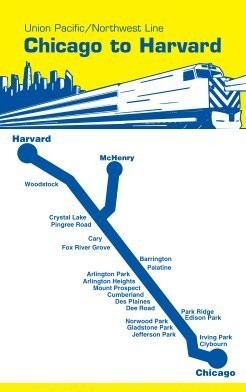
May, 2000: Mt. Prospect Illinois. I’m standing on a sidewalk near a Metra rail line near a stopped train near a bundle on the tracks. A 23-year-old male, it later turns out, intentionally stopped his car, left the door open, and stepped in front of the train.
The phrase blood on the tracks, always lurking somewhere inside my skull, is finally applicable to real life.
Policemen, looking unhappy, walk the siding, marking bits with little flags. Firemen stand around in groups. A cop finds a sodden red tennis shoe at least 100 yards from the point of impact. “Won’t they let you get any closer?” asks a bystander.
“Why would I want to get any closer?”
A photographer from the Tribune shows up, says he remembers a dog that was hit by a train in Vietnam and survived with two legs. A photographer from the Herald arrives. We all make the obligatory nervous jokes, snap a few pictures. The Herald guy says his pictures won’t run anyway. “I don’t know what your photo policy is, but we don’t run suicides.”
“You have a photo policy?” I ask. “Cool.”

I wanted a Spiritually Dead card to send a friend, but that rack was sold out. This will do in a pinch.
At age 12, soon after Christmas, a major snowstorm hit, nixing school. My neighbor Virgil and I, both at home alone, trudged across the nearby golf course in high spirits, him sporting a pricey shearling coat, his main gift.
The course was bounded by a creek, which we found to be frozen. Or partially, as we realized when Virgil crackled through and plunged to his chest. I extended a tree limb to drag him out.
The trudge back was subdued. Only my legs had gotten wet, but I was shivering uncontrollably, and Virgil’s white fleece trim, now caramel, had frozen solid. At home he discovered he was locked out. I had my key, but our place had no laundry dryer, and he was in a panic about the coat. Luckily, he knew a way to break in.
Our houses, built at the end of the Depression, each had a long-disused metal door, roughly three feet wide, built into the foundation at ground level. In those earlier times a guy would deliver coal by shoveling it through the opening and down a chute to a boiler, now long gone.
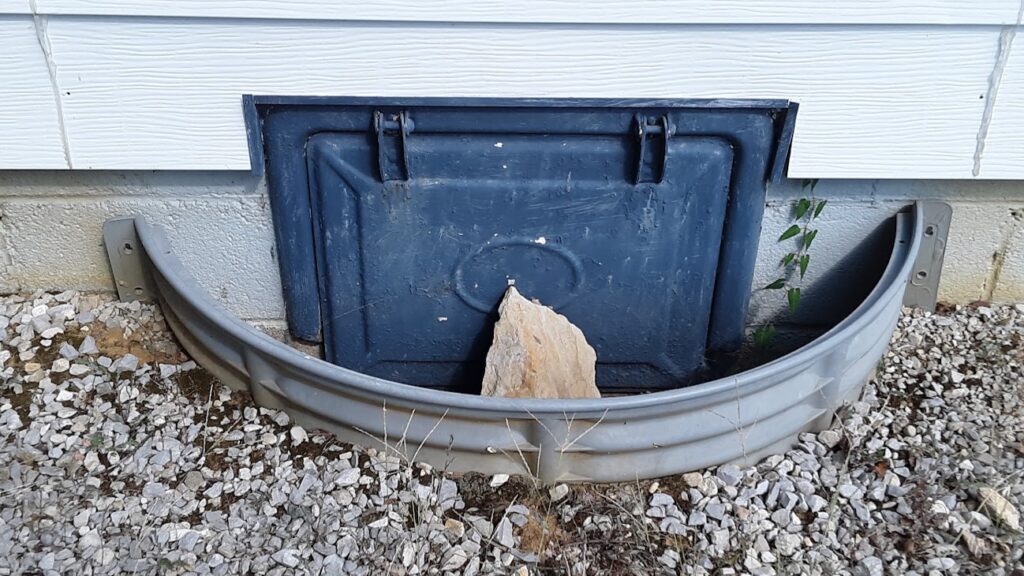
The actual portal!
Virgil managed to pry the hatch open but hesitated to squirm through on his belly and cause even more damage to the coat. Then he hit upon a solution: He would lay face up on a cheap toboggan and carefully scooch forward until he could reach an overhead water pipe in the basement and swing his legs inside.
I was still deciding where to grip the wet plastic for support when he shot through the hatch with a shriek and crashed to the concrete floor. He landed on his head yet broke his leg.
It took me several minutes to squirm inside without stepping on him, and another ten to get him upstairs, where he phoned and asked his no-nonsense father to leave work early. He wouldn’t let me wash the coat, and there was nothing else I could do, really.
The next time I saw Virgil his cast was covered with signatures and due to come off any day. He never told me how he explained the incident to Dad.
(Because at small newspapers that’s what you did.)

We’re parked at the Picture Rocks trailhead in Saguaro National Park, sorting water and supplies into a backpack for a hike in the 85-degree midmorning heat.
As we’re finishing, a grizzled older man parks a pickup and unloads a noticeably hissing, sealed five-gallon bucket from the bed, along with aluminum snake tongs. I ask, Is that a rattler? It is. Sounds big. A big one, he confirms, and sets off on foot.
A few minutes later we follow down the trail, which quickly narrows into a canyon. A quarter mile along we find him rising from a crouch, the bucket now empty. He gestures to spot roughly three feet off the trail, indicating a shadowed cleft at ankle level. Indeed, we can see eyes and a flickering tongue. A head as large as my fist.
While hiking, it occurs to me that neither his truck nor clothes specified any official status.
Hours later, at a visitor center packed with kids, I can’t help but wonder what made a seemingly competent local guy bypass dozens of roadside turnouts spread across thousands of acres to release a big one on a trail popular enough to be included in every guidebook.